
Cherry Hill Roofing has handled roof replacement in Cherry Hill, NJ for more than 20 years, serving surrounding cities including Haddonfield, Haddon, Collingswood, Bellmawr and Gloucester City. We replace roofs on split-levels, colonials, ranches, twins and rowhouses, and on the flat and low-slope roofs of small commercial buildings.
A new roof is a large purchase, and the quality is mostly hidden once the shingles are on. What separates a roof that lasts from one that leaks in five years is the work underneath: the decking, the ice barrier at the eaves, the flashing at every wall and chimney, and ventilation that keeps the attic from cooking the shingles.
That is why our written scope lists tear-off, decking, underlayment, flashing, ventilation and gutters as separate lines. You can see exactly what is included, compare it item by item against any other estimate, and know what you are paying for before the first shingle comes off.
Residential Roof Replacement
When Replacement Makes Sense
We recommend replacement only when repair no longer makes financial sense. The signs are usually spread across the whole roof: shingles losing granules down to the mat, tabs that crack instead of bending, curling edges, and leaks appearing in new places after each repair.
Age alone is not the deciding factor. A well-ventilated roof can outlast its expected life, while a poorly ventilated one can fail early. We show you photos of what we find and explain how much life a repair would realistically buy, so the decision is yours to make with the facts in front of you.
Tear-Off Versus Overlay
An overlay puts new shingles over the old layer. It saves the cost of removal, but it hides the deck, keeps old flashing in place, and adds weight to the framing. In New Jersey, a full tear-off is required once two layers are already on the roof, so many older houses here have no overlay option left.
Even where an overlay is allowed, we recommend tearing off in most cases. Stripping to the deck is the only way to find rot, replace failed flashing, and install an ice and water barrier and synthetic underlayment directly on the wood where they work best.
Shingle Lines and Performance Ratings
Most of our replacements use architectural laminated shingles such as GAF Timberline HDZ, Owens Corning Duration or CertainTeed Landmark. They are thicker and more dimensional than three-tab shingles and come in colors that suit brick, stone and siding.
Ratings help compare products. ASTM D3161 Class F and ASTM D7158 Class H describe wind resistance, UL 2218 Class 4 marks the highest impact resistance, and ASTM E108 or UL 790 Class A is the top fire rating. We explain which ratings are worth paying more for on your house and which are not.
Underlayment, Ice Barrier and Drip Edge
Under the shingles, a self-adhering ice and water barrier meeting ASTM D1970 goes along the eaves, in valleys and around penetrations, where water is most likely to back up. The rest of the deck is covered with synthetic underlayment meeting ASTM D8257, which resists tearing and stays flat better than old felt paper.
Drip edge is installed at the eaves and rakes so water drips clear of the fascia rather than wicking back behind the gutter. These layers are invisible on a finished roof, which is exactly why they are written into the scope as their own lines.
Flashing and Ventilation
When we replace a roof, the flashing is replaced too. Step flashing at walls, counter flashing set into a reglet at chimneys, apron flashing, kick-outs and new pipe boots all go in fresh rather than being reused or caulked over.
Ventilation gets the same attention. We calculate the net free area needed for soffit intake and ridge exhaust and correct mixed or blocked systems. A balanced attic keeps the shingles cooler in summer, reduces ice dams in winter, and is often a requirement of the shingle warranty.
Commercial Roof Replacement
Flat and Low-Slope Roof Systems
Small commercial buildings usually need a membrane system rather than shingles. We replace flat roofs with EPDM rubber membrane, TPO or PVC single-ply membranes, or torch-down SBS or APP modified bitumen, depending on the building’s use, drainage and budget.
A replacement is also the time to fix drainage. We look at where water has ponded, check drains and scuppers, and add tapered insulation or crickets where needed so water leaves the roof instead of sitting on the new membrane.
Working Around an Open Business
Commercial replacements are planned around the people inside. We schedule noisy tear-off work and crane deliveries to limit disruption, keep entrances clear, and protect rooftop equipment during the work.
We also coordinate with your mechanical contractor when rooftop units need to be lifted or reconnected, so the new membrane can be flashed properly at each curb rather than worked around.
Permits, Contracts and Paying for a New Roof
Permits in New Jersey and Pennsylvania
New Jersey treats replacing the roof covering on a detached one- or two-family house as ordinary maintenance under N.J.A.C. 5:23-2.7, so no construction permit is needed. Houses inside a local historic district may still need design review before work begins.
Pennsylvania is less uniform. The state construction code exempts some repairs, but townships set their own re-roofing requirements, and some ask for a permit and inspection photos for every tear-off. We check the rule for your township before scheduling a Pennsylvania job.
Contracts, Cancellation Notices and Sales Tax
Each contract follows the home improvement rules of the state the house is in, including the homeowner’s cancellation notice. New Jersey and Pennsylvania each have their own requirements, and a contract written to the wrong state’s rules can leave out protections you are entitled to.
In New Jersey, a full replacement is generally an exempt capital improvement documented on Form ST-8, so no sales tax is charged on the job. In Pennsylvania, roofing contractors pay sales tax on the materials they buy, so it does not appear as a separate line on your invoice.
Decking and Change Orders
Damaged decking is the most common surprise in a roof replacement. Our contracts set a per-sheet price for decking replacement in advance, so if rot is found once the old roof is off, the cost per sheet is already agreed.
Before any sheet is replaced, we photograph it and show it to you. You approve the count, and the final invoice matches what you saw, rather than an unexplained figure added at the end.
Our Step-by-Step Roof Replacement Process
Step 1: Inspection and Written Scope
We inspect the roof and the attic, measure every slope, and count layers at the edges. The written scope lists each part of the job separately, along with the shingle line, the decking price per sheet and the payment schedule.
Step 2: Color and Material Selection
Shingle color is chosen at your house, with full-size samples held against the brick, stone or siding in daylight. Photos and small swatches can mislead, and the color is the one decision you will look at every day for decades.
Step 3: Tear-Off and Deck Inspection
On installation day, tarps protect shrubs, siding and windows, and the old roof is stripped to the deck. We inspect every sheet of decking, replace damaged sections after showing them to you, and renail loose boards.
If solar panels are on the roof, their removal is scheduled before this step with the solar installer, and the mounts are reflashed before the panels go back on. Planning that sequence in advance keeps the house from sitting with an open roof while everyone waits on the solar crew.
Step 4: Installation
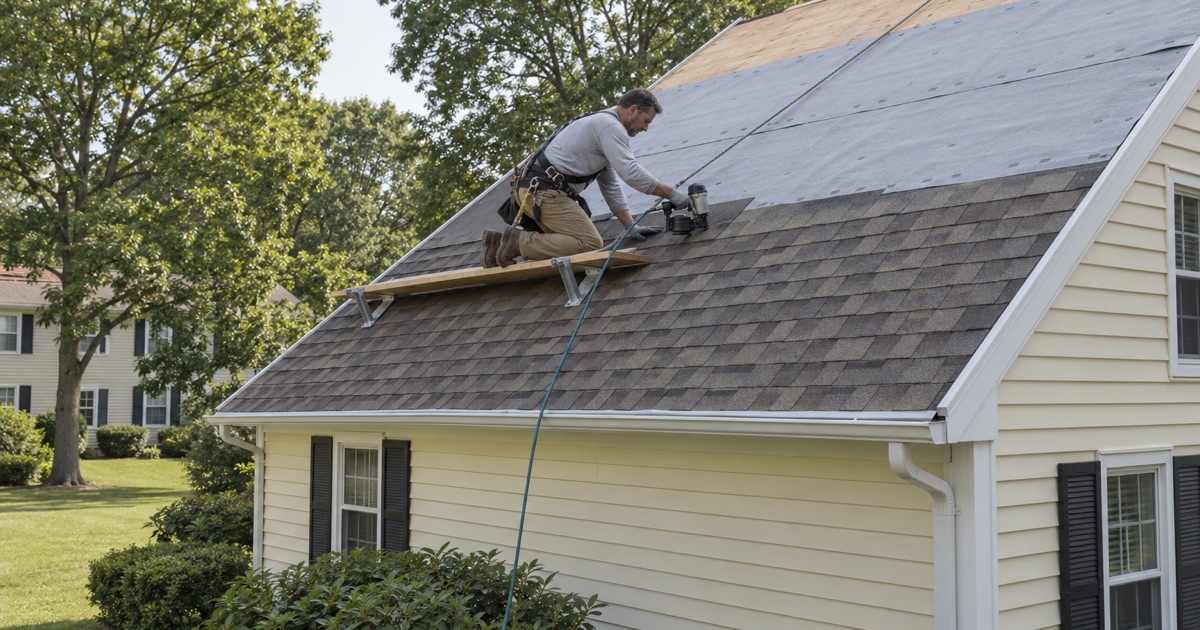
Drip edge, ice and water barrier, synthetic underlayment, flashing and ventilation go on in order, followed by the shingles, hip and ridge caps. Each layer laps over the one below so water always runs outward and down.
Step 5: Cleanup and Final Walk-Through
At the end of each working day, the yard, driveway and gutters are cleared and a magnet sweep picks up loose nails. When the roof is complete, we walk through it with you, hand over the warranty paperwork, and answer any questions about maintenance.
- 20+ Years on Local Roofs
- Repair-First Advice
- Itemized Written Scopes