
Cherry Hill Roofing provides chimney flashing repair in Cherry Hill, NJ, serving surrounding cities including Haddonfield, Haddon, Collingswood, Bellmawr and Gloucester City. In more than 20 years of tracing leaks through local attics, the chimney has been one of the most common places we find water getting in, especially on older houses where the original flashing has rusted or been patched over many times.
A chimney is a large masonry box passing through the roof, and the roof and the chimney move independently as the house heats, cools and settles. The flashing is what keeps that joint watertight, and it has to be built in layers that allow the movement while shedding water at every point.
When that flashing fails, the usual quick fix is a thick bead of caulk or roofing cement along the joint. It may stop the drip for a season, but it cracks as the roof and masonry move, and it often traps water behind it. We replace failed flashing rather than caulking over it, so the repair lasts as long as the roof around it.
How Chimney Flashing Works
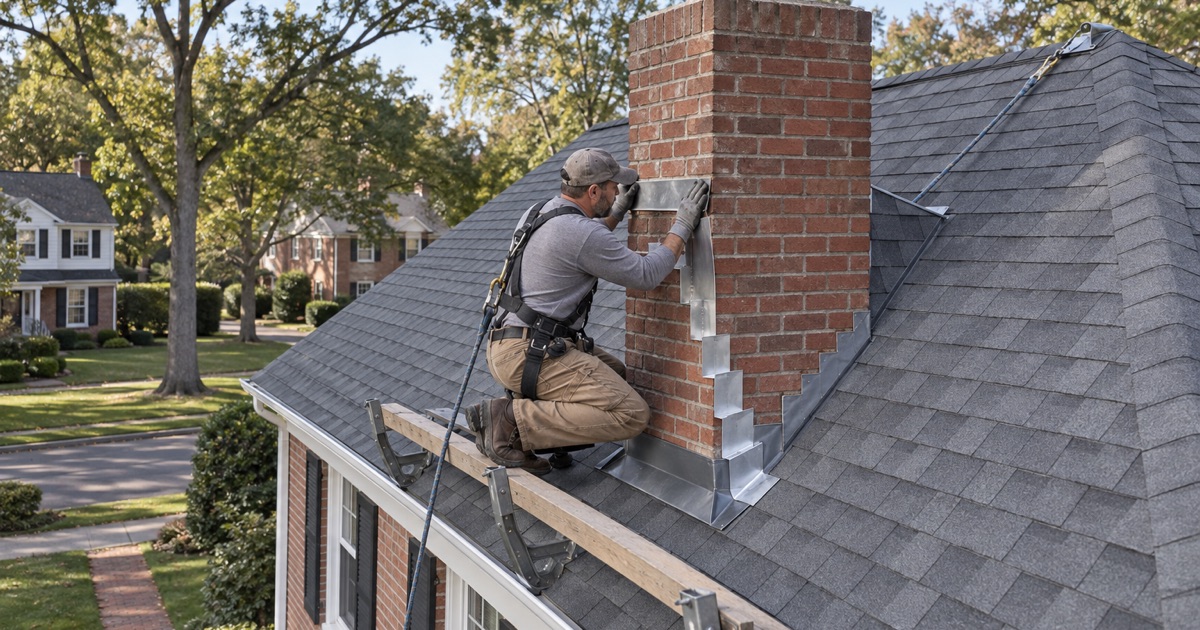
Step Flashing Along the Sides
Along the sides of the chimney, individual pieces of step flashing are woven into each course of shingles. Each piece turns up against the brick and laps over the one below it, so water running down the roof is carried past the chimney rather than into the joint.
When step flashing is missing, too short or rusted through, water runs straight down the side of the chimney into the attic. That shows up as staining on the framing next to the chimney and, eventually, on the ceiling below.
Counter Flashing Cut Into the Mortar
Counter flashing covers the top edge of the step flashing and keeps water from getting behind it. Done properly, it is cut into a reglet, a groove in the mortar joint, and bent down over the step flashing so the two can move independently.
Many failed chimneys we see have counter flashing glued or nailed to the face of the brick and sealed with caulk. When that caulk dries out, water runs straight behind the flashing. Cutting a reglet takes more time, but it is the detail that lasts.
Apron Flashing and the Chimney Cricket
On the downhill face of the chimney, apron flashing laps over the shingles below. On the uphill side, water and debris coming down the roof hit the back of the chimney, which is where the largest leaks often start.
On wide chimneys, we build a cricket, also called a saddle, on the uphill side. Its small peaked shape splits the water and sends it around both sides of the chimney, so leaves and snow do not pile up against the masonry.
Signs Your Chimney Flashing Needs Repair
Inside the House and the Attic
Water stains on the ceiling or wall next to the chimney are the most obvious sign. In the attic, dark or damp framing beside the chimney, rusted nails and water trails down the rafters point to flashing failure.
Leaks that appear only during heavy, wind-driven rain often come from the uphill side of the chimney or from counter flashing that has pulled away from the brick. A leak that shows up days after the rain has stopped can also mean water is soaking through the masonry rather than the flashing.
On the Roof
From the roof, failing flashing shows as rust, gaps between the metal and the brick, bent or lifted pieces, and thick layers of old roofing cement smeared over the joints. Shingles that are curled or stained next to the chimney also suggest water has been running where it should not.
We photograph what we find so you can see the condition of the flashing yourself before deciding on the repair. Most homeowners have never seen the top of their own chimney, and the pictures usually explain the leak better than any description.
Chimney Flashing Repair and Replacement
Replacing Flashing on an Existing Roof
To replace chimney flashing without reroofing, we remove the shingles around the chimney, take out the old flashing, and install new step, counter and apron flashing. The shingles are then woven back in, with new matching shingles where the old ones cannot be reused.
If decking around the chimney has softened from years of leaking, we show you and replace it while the area is open. Covering rotted wood with new flashing only sets up the next failure.
Flashing With a New Roof
When a roof is replaced, the chimney flashing should be replaced too. Reusing old flashing under new shingles saves a little money and is one of the most common reasons new roofs leak.
We replace chimney flashing on every roof replacement as a matter of course, along with the flashing at walls, skylights and anywhere two roofs meet. The new flashing is listed as its own line in the written scope, so you can confirm it is included when comparing estimates.
Chimneys on Slate and Older Roofs
On slate roofs and many older houses, chimney flashing was often made of copper or lead and laid in with the slate itself. Those materials can last a very long time, but the soldered joints, the counter flashing and the mortar around them eventually give way.
We repair these chimneys with matching metal where possible and work the slate back in with hooks or copper nails, rather than switching to thin aluminum and smearing tar over the slate. On a house with a historic character, the flashing is part of what makes the roof look right, and it deserves the same care as the slate around it.
When the Chimney Itself Is Leaking
Not every chimney leak is a flashing problem. A cracked crown, a missing cap, or porous brick and mortar can let water into the chimney, where it runs down inside and shows up in the same places as a flashing leak.
We check the crown, cap and visible masonry while we are on the roof. If the masonry needs repointing or rebuilding, we tell you what we see so you can involve a mason, since flashing alone will not stop water that is coming through the brick.
- 20+ Years on Local Roofs
- Repair-First Advice
- Itemized Written Scopes