
Cherry Hill Roofing provides commercial roofing in Cherry Hill, NJ, serving surrounding cities including Haddonfield, Haddon, Collingswood, Bellmawr and Gloucester City. For more than 20 years we have repaired and replaced the flat and low-slope roofs on offices, storefronts, mixed-use buildings and other small commercial properties across South Jersey and the Philadelphia suburbs.
Commercial roofs fail differently from house roofs. Water does not run off quickly, so every seam, drain and flashing detail carries more weight, and a small problem can travel a long way under the membrane before it shows as a stained ceiling tile. Tenants, inventory and equipment underneath also make a leak more expensive than it would be on a house.
We approach commercial work the same way we approach a house: find the real cause before pricing anything, give a straight answer on whether repair will do, and write the scope so each part of the job is listed and priced on its own line. Property owners and managers can then compare bids on what is actually included.
Flat and Low-Slope Roof Systems
EPDM Rubber Membrane
EPDM is a synthetic rubber membrane that has covered flat roofs for decades. It is flexible in cold weather, resists weathering, and is straightforward to repair, which makes it a sensible choice for many small commercial buildings and rowhouse-style storefronts.
Its weak points are the seams and the flashing at walls and curbs, which rely on adhesives and tapes. We pay close attention to those details on installation and check them on every maintenance visit, since an open lap is the most common EPDM leak.
TPO and PVC Single-Ply Membranes
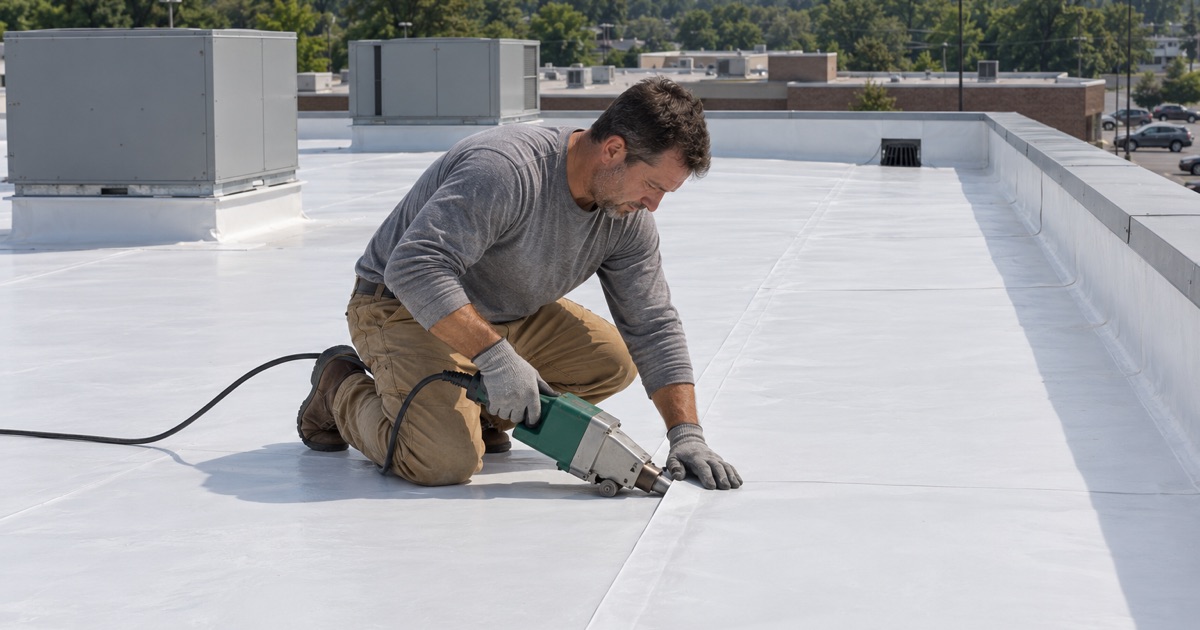
TPO and PVC are single-ply membranes with seams that are heat-welded rather than glued. A welded seam becomes one piece with the sheet around it, and the light-colored surface reflects summer heat, which can lower cooling loads in the building below.
PVC holds up particularly well where grease or chemicals reach the roof, such as near restaurant exhaust fans. TPO is a common choice for general commercial roofs. We help you weigh the two against the roof’s use and your budget.
Modified Bitumen
Torch-down SBS and APP modified bitumen roofs are built from asphalt-based sheets in multiple layers. They are tough, resist punctures from foot traffic and dropped tools, and are often used where service technicians walk the roof regularly.
Installation requires care at walls and edges, especially where torch-applied sheets meet wood or other combustible materials. On those areas, we use self-adhered or cold-applied details to keep the work safe.
Commercial Roof Repair and Maintenance
Leaks, Seams and Drains
Most commercial leaks come from split or open seams, punctures, blistered membrane and drains that clog and let water pond. Because water travels under a membrane, the leak inside the building is often some distance from the entry point on the roof.
We trace the leak, repair it with materials compatible with the existing membrane, and clear drains, gutters and scuppers. A roof that drains properly lasts far longer than one where water sits for days after every storm.
Rooftop Equipment, Parapets and Edges
Rooftop HVAC units, exhaust fans and skylights all need flashed curbs, and they bring service technicians onto the roof several times a year. Parapet walls and coping caps add another set of joints where water can get into the wall below.
We reflash curbs, repair or replace coping, and recommend walkway pads along service routes. Those small steps prevent the repeated punctures and edge failures that shorten so many commercial roofs.
Commercial Roof Replacement
Recover Versus Tear-Off
When a commercial roof reaches the end of its life, a recover over the existing roof is sometimes possible and can save on removal costs. It only works if the existing roof and insulation are dry, since trapped moisture under a new membrane rots the deck and causes early failure.
We check the existing roof for wet areas before recommending a recover. Where moisture is widespread, a full tear-off is the honest recommendation, and the written scope explains why.
Insulation and Tapered Drainage
A replacement is the best chance to fix ponding. Tapered insulation creates slope toward drains and scuppers, and crickets between drains move water that would otherwise sit in low spots.
Adding insulation during a replacement can also reduce heating and cooling costs. We plan the insulation thickness around existing door thresholds, curbs and flashing heights, so the new roof does not create problems at the edges.
Scheduling Around Tenants and Customers
Commercial work is planned around the people inside the building. We schedule tear-off, crane deliveries and noisy work to limit disruption, keep entrances and parking clear, and dry in each section of roof by the end of the day.
We also coordinate with your mechanical contractor when units need to be lifted or reconnected, so the new membrane is flashed properly at every curb rather than worked around equipment that stayed in place.
Commercial Buildings We Work On
Offices, Storefronts and Mixed-Use Buildings
Many commercial buildings in the area are small offices, retail storefronts, and mixed-use buildings with apartments over shops. Their roofs are often flat or low-slope behind a parapet, with gutters or scuppers at the back.
These buildings share features with rowhouses, including shared walls and parapets with the building next door. We detail the joints with neighboring roofs carefully so the new membrane ties in cleanly without sending water into either building.
Apartment and Multifamily Buildings
Garden apartments, small apartment buildings and converted multifamily houses often combine pitched shingle sections with flat roofs over rear wings and stair towers. Each part needs its own system, and the transitions between them are where leaks tend to start.
On occupied buildings, we plan the work so residents keep safe access to entrances and parking, give notice before noisy days, and protect balconies and walkways below the roof edge. Owners get a written scope that separates the shingle work from the flat roof work, so each can be priced and scheduled on its own if the budget requires it.
- 20+ Years on Local Roofs
- Repair-First Advice
- Itemized Written Scopes